

 Tiếng Việt

Exploring the Uniqueness of the Mekong Delta Dialect: A Journey to Experience Culture Through Language. The Mekong Delta dialect – Vietnam’s Western region, a land famous for its vast rivers, abundant orchards, and generous people – not only attracts tourists with its natural beauty but also with its unique cultural charm, clearly expressed through its local dialect. The Mekong Delta dialect is not just a means of communication; it is a cultural treasure trove, preserving the history, customs, traditions, and distinctive character of its people. This article will take you on a journey to discover the uniqueness of the Mekong Delta dialect, from its phonetic characteristics to its proverbs and idioms that bear the strong imprint of the region.
>>> “Strange yet Familiar”: 7749 Western Vietnamese Dialect Words Not Everyone Knows.
>>> Good Sayings About the Mekong Delta: The Soul of the Riverine Region.
>>> 1001 Western Vietnamese “Insults”: Seemingly Distant, Yet Truly Affectionate.
Danh mục bài viết
Exploring the Uniqueness of the Mekong Delta Dialect
1. Phonetic Characteristics of the Mekong Delta Dialect
The Mekong Delta dialect possesses distinct phonetic characteristics that differentiate it from standard Vietnamese and other regional dialects. Some prominent features include:
- Pronunciation: People in the Mekong Delta often tend to pronounce vowels and consonants less clearly, sometimes “swallowing” sounds or mispronouncing them. For example, the “o” sound might be pronounced as “oa”, and the “a” sound might be pronounced as “â”.
- Tones: The Mekong Delta dialect has fewer tones compared to standard Vietnamese. Some tones are omitted or merged, creating differences in intonation and expression.
- Vocabulary: The Mekong Delta dialect has many characteristic local words that are not used in standard Vietnamese. For example, “cây dừa” (coconut tree) is called “cây kẹo”, and “con cá lóc” (snakehead fish) is called “con cá trê”.
- Grammar: The grammar of the Mekong Delta dialect also has some differences from standard Vietnamese. For instance, the order of sentence components might change, or specific particles and auxiliary words might be used.
2. Exploring the Uniqueness of the Mekong Delta Dialect – Characteristic Vocabulary of the Mekong Delta Dialect
The Mekong Delta dialect possesses a rich vocabulary that reflects the life, culture, and people of the region. Here are some examples of characteristic vocabulary:
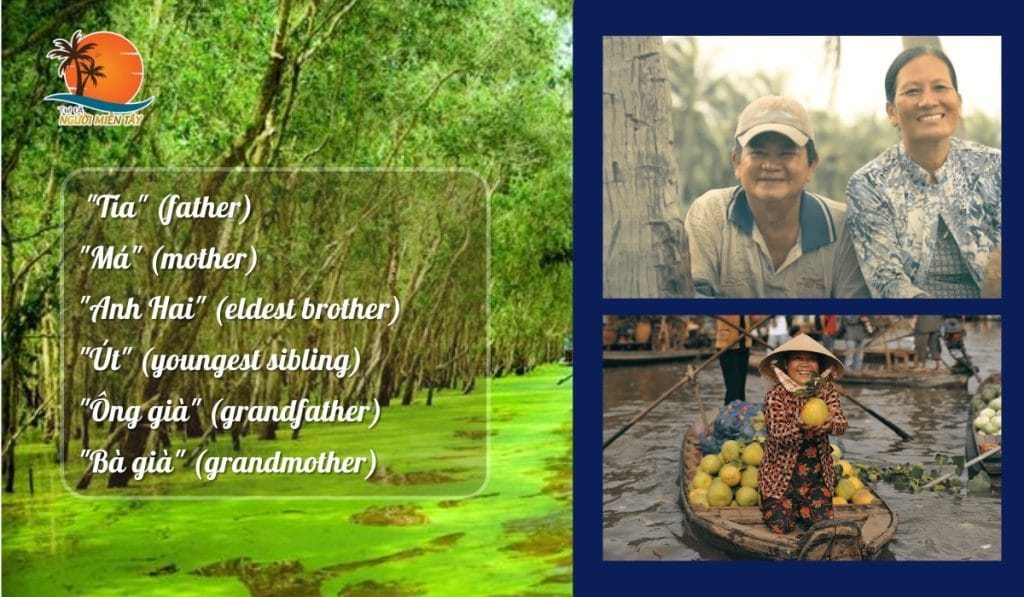
Mekong Delta Dialect – Characteristic Vocabulary
- Referring to People: “Tía” (father), “Má” (mother), “Anh Hai” (eldest brother), “Út” (youngest sibling), “Ông già” (grandfather), “Bà già” (grandmother).
- Referring to Objects: “Cây kẹo” (coconut tree), “Con cá trê” (snakehead fish), “Bắp” (corn), “Khoai mì” (cassava), “Ổi” (guava).
- Referring to Actions: “Làm dữ” (to do strongly/fiercely), “Điệu” (to pose/act graceful), “Hết hồn” (to be startled/extremely surprised), “Ráng” (to try hard/endeavor).
- Referring to Qualities: “Ngon lành” (delicious/excellent), “Đã” (satisfying/pleasing), “Ghê” (terrible/frightening), “Dữ dội” (intense/powerful).
3. Idioms and Proverbs Bearing the Strong Imprint of the Mekong Delta

Idioms and proverbs are an indispensable part of the Mekong Delta dialect. They are often used to express life experiences, philosophies of life, and the cultural values of the local people. Some examples include:
- “Ăn cây nào rào cây nấy”: (Literally: Eat from which tree, fence that tree) – Meaning: Be grateful to those who help you; acknowledge your roots. (Equivalent to: “Eat the fruit, remember the planter” or “Drink water, remember the source”).
- “Uống nước nhớ nguồn”: (Literally: Drink water, remember the source) – Meaning: Show gratitude to those who have helped or supported you.
- “Đi một ngày đàng, học một sàng khôn”: (Literally: Go one day’s journey, learn a basketful of wisdom) – Meaning: Traveling widely broadens one’s knowledge and understanding.
- “Ếch ngồi đáy giếng”: (Literally: Frog sitting at the bottom of a well) – Meaning: Referring to people with limited perspective or narrow-mindedness.
- “Trâu chậm uống nước đục”: (Literally: Slow buffalo drinks muddy water) – Meaning: Those who are slow or indecisive often miss out or face disadvantages.
4. The Mekong Delta Dialect in Culture and Daily Life
The Mekong Delta dialect is not only used in daily communication but also appears in literature, art, and other cultural activities. Many literary works, songs, and films have utilized the Mekong Delta dialect to create a sense of familiarity, authenticity, and distinctiveness.
5. Value and Preservation of the Mekong Delta Dialect
The Mekong Delta dialect is an important part of Vietnam’s intangible cultural heritage. It is not just a means of communication but also a cultural treasure trove, preserving the history, customs, traditions, and distinctive character of the people of the Mekong Delta. Preserving and promoting the value of the Mekong Delta dialect is the responsibility of every citizen, especially the younger generation.
The Mekong Delta dialect is an indispensable part of the culture and people of this region. It is not just a means of communication but also a cultural treasure trove, preserving the history, customs, traditions, and distinctive character of the people of the Mekong Delta. Exploring and learning about the Mekong Delta dialect is a fascinating journey that helps us understand more about this land and its people.
>>> Back to the Mekong Delta! Any Season is Fun for Tourism.


